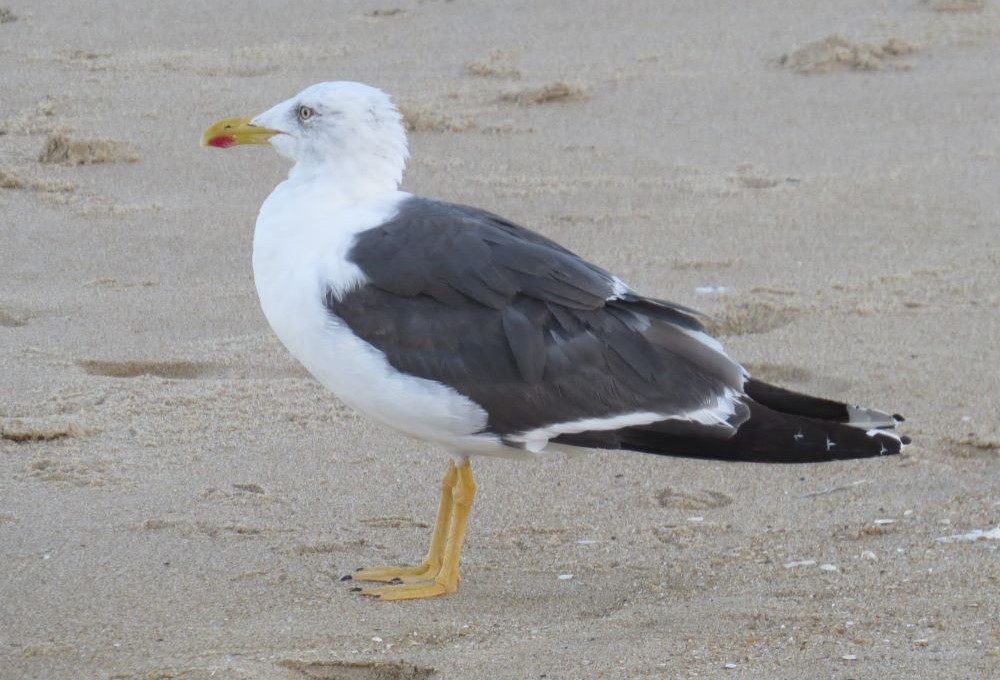
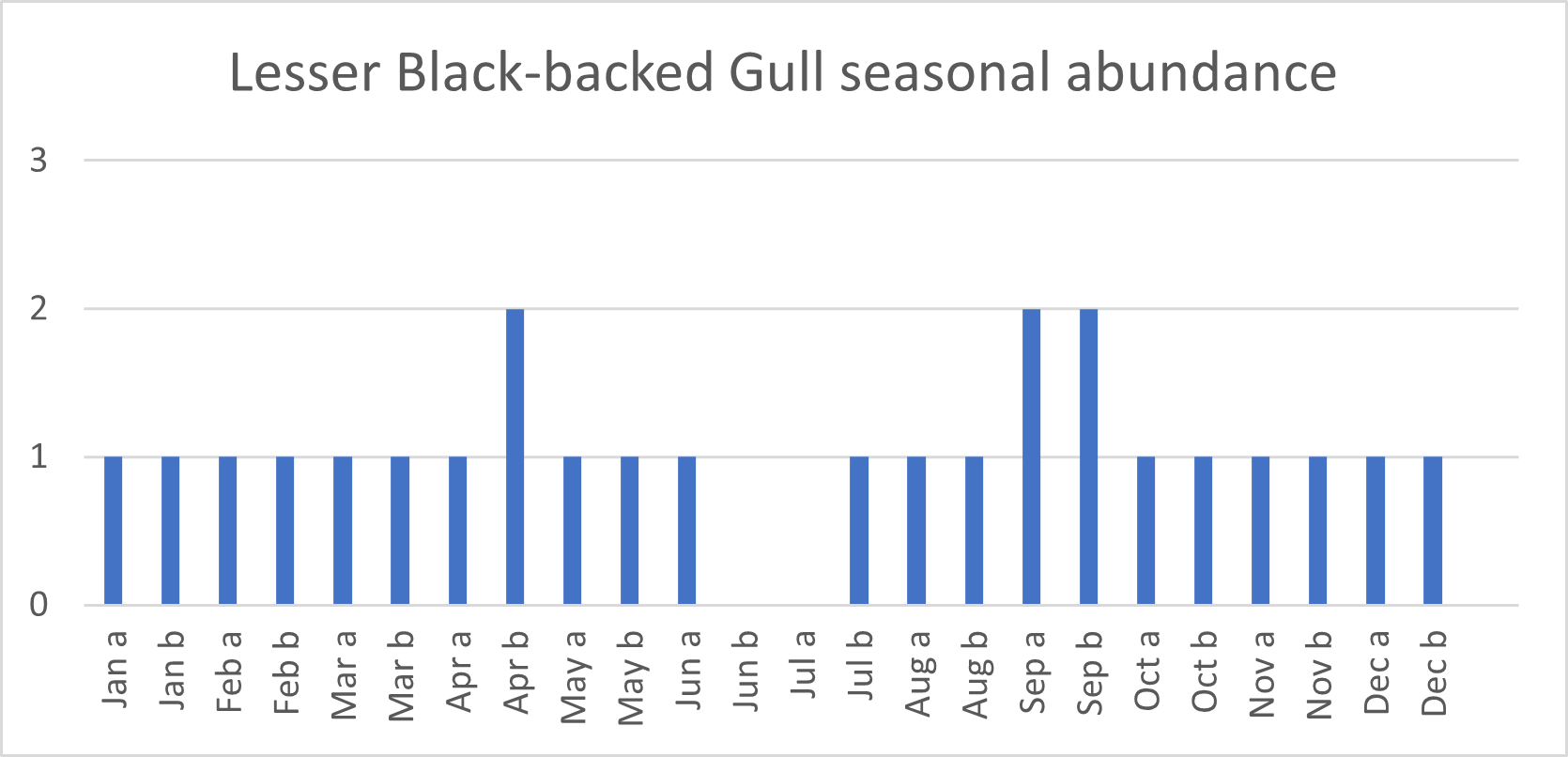
The Lesser Black-backed Gull is a primarily European species that was largely unknown in North America prior to the 1980s. For reasons largely unknown, numbers have increased since then and it is now a regular – if rare – visitor to coastal New Hampshire. Most records come from early fall, but it has been reported throughout the year except in mid-summer. Adults are easily distinguished from our more common large gulls with a good look. They are roughly the size of an American Herring Gull but have a slate-gray back and yellow legs. The latter feature also separates them from the Great Black-backed Gull, which is darker black and has pink legs. Immatures are much trickier and should be identified with caution.
Lesser Black-backed Gulls breed in Greenland, where the population appears to be increasing, a trend likely behind increasing reports along the east coast all the way to Florida. Despite the species’ growing population, there have been only two nesting records in North America away from Greenland. One was a failed mating with an American Herring Gull in Alaska in 1993, bur the second became a local celebrity. From 2007 to 2011, a male Lesser Black-back (nicknamed “Pierre”) mated with an American Herring Gull on Appledore Island in the Isles of Shoals. Several chicks were produced, and banded hybrids were reported as far away as Florida during the winter.
Relative abundance based on eBird data. Numbers indicate likelihood of finding this species in suitable habitat at a given time of year, not actual numbers encountered.
Lesser Black-backed Gull Range Map
= Breeding
= Winter
= Migration
= Year Round
Information for the species profiles on this website was compiled from a combination of the sources listed below.
The Birds of New Hampshire. By Allan R. Keith and Robert B. Fox. 2013. Memoirs of the Nuttall Ornithological club No. 19.
Atlas of the Breeding Birds of New Hampshire. Carol R. Foss, ed. 1994. Arcadia Publishing Company and Audubon Society of New Hampshire
Birds of the World. Various authors and dates. Cornell Laboratory of Ornithology.