Barrow’s Goldeneye is a much-sought prize hidden within flocks of the far more widespread Common Goldeneye. Males of the two species are very similar and separated by sometimes subtle differences on the head and wings. The white facial spot on Barrow’s is crescent-shaped while it is round on Commons, and Barrow’s has less white on the folded wing – giving the appearance of alternating black and white spots versus a large white patch. Females of the two species are extremely similar, with Barrow’s typically having an all yellow or orange bill. Common Goldeneye females never have more than the tip of the bill this color.
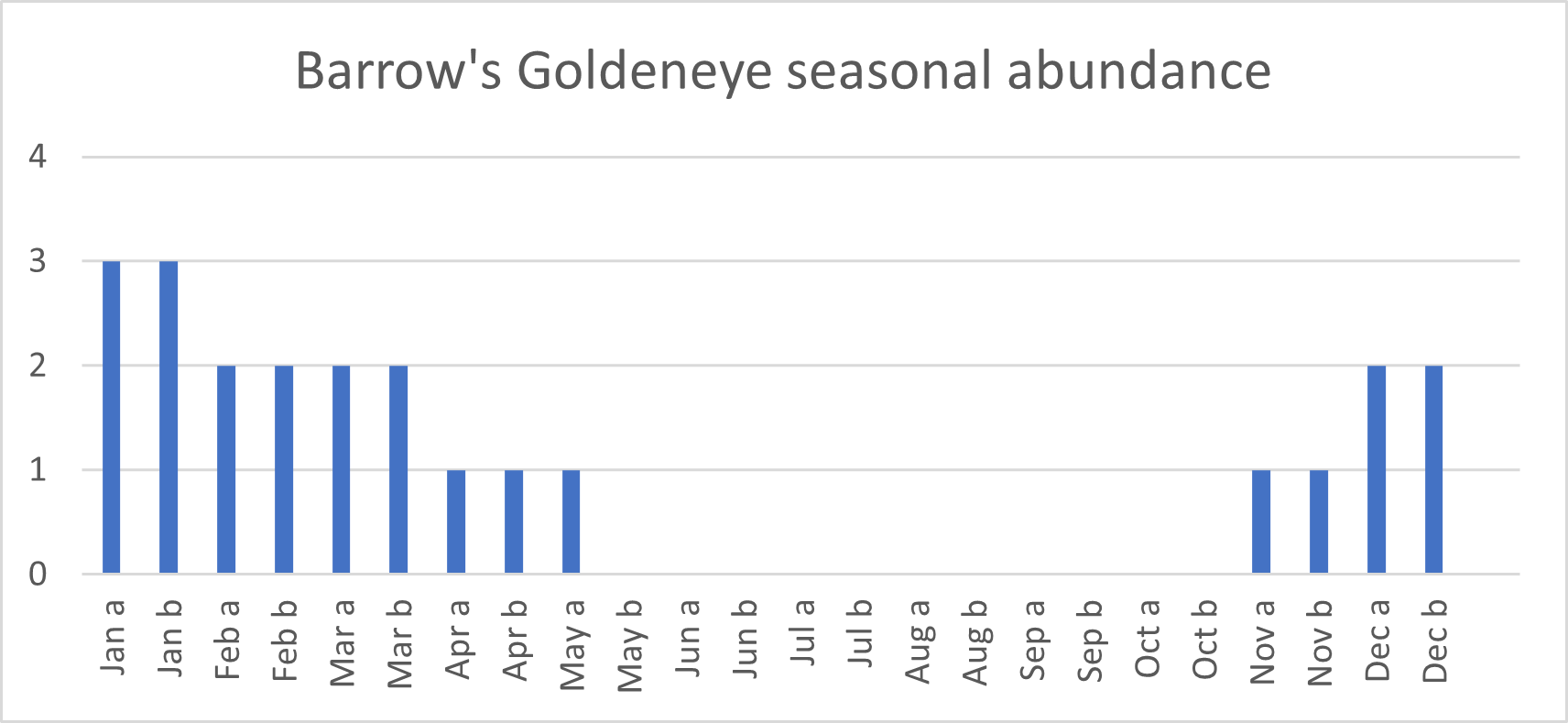
Most Barrow’s Goldeneyes nest in western North America, but there is a small breeding population in Quebec and Labrador that spends the winter along the coast between Quebec and Long Island. They typically occur in New Hampshire between November and April, when they are most likely along the Merrimack River and in the Lakes Region. They are less frequent along other major rivers and on the coast. Like the Common Goldeneyes with which they associate, Barrow’s feed by diving in search of mussels and crustaceans.
Relative abundance based on eBird data. Numbers indicate likelihood of finding this species in suitable habitat at a given time of year, not actual numbers encountered.
Barrow’s Goldeneye Range Map
= Breeding
= Winter
= Migration
= Year Round
Information for the species profiles on this website was compiled from a combination of the sources listed below.
The Birds of New Hampshire. By Allan R. Keith and Robert B. Fox. 2013. Memoirs of the Nuttall Ornithological club No. 19.
Atlas of the Breeding Birds of New Hampshire. Carol R. Foss, ed. 1994. Arcadia Publishing Company and Audubon Society of New Hampshire
Birds of the World. Various authors and dates. Cornell Laboratory of Ornithology.