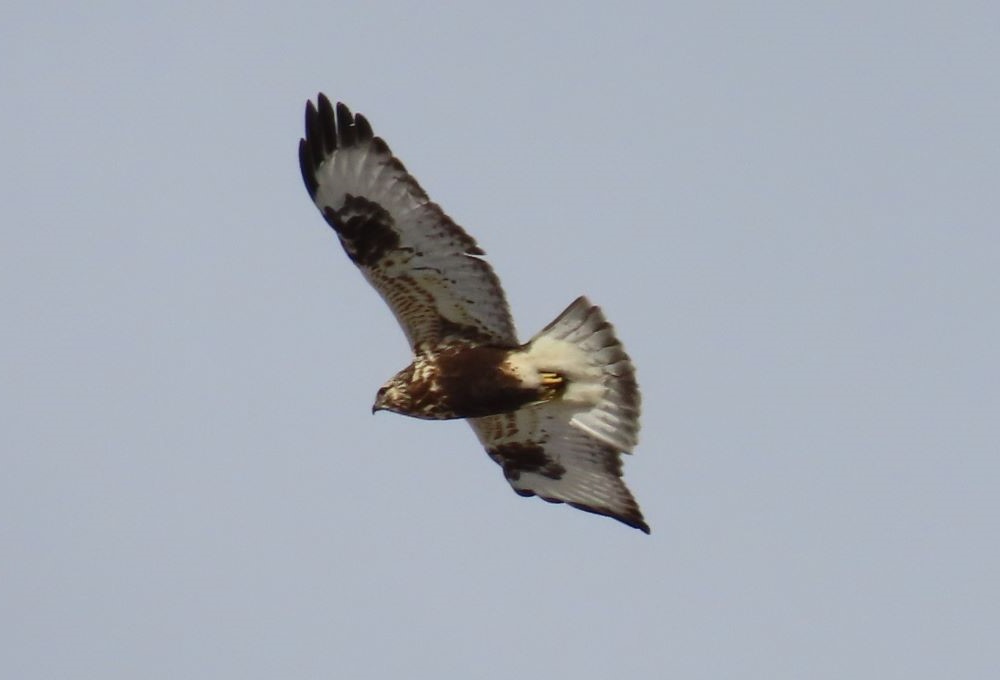
The Rough-legged Hawk breeds far to the north on the Canadia tundra and spends the winter in open country across most of the United States (it is absent from the Southeast). As an adaption to the cold climates in which it lives, its legs are feathered all the way to the feet, a feature not seen in other North American Buteo hawks. Like the Snowy Owls which share its breeding range, the Rough-legged Hawk feeds primarily on small mammals, and numbers fluctuate with prey cycles. A classic way to identify a distant hunting Rough-leg is to see it hovering intently over a field in preparation to dive down after a vole.
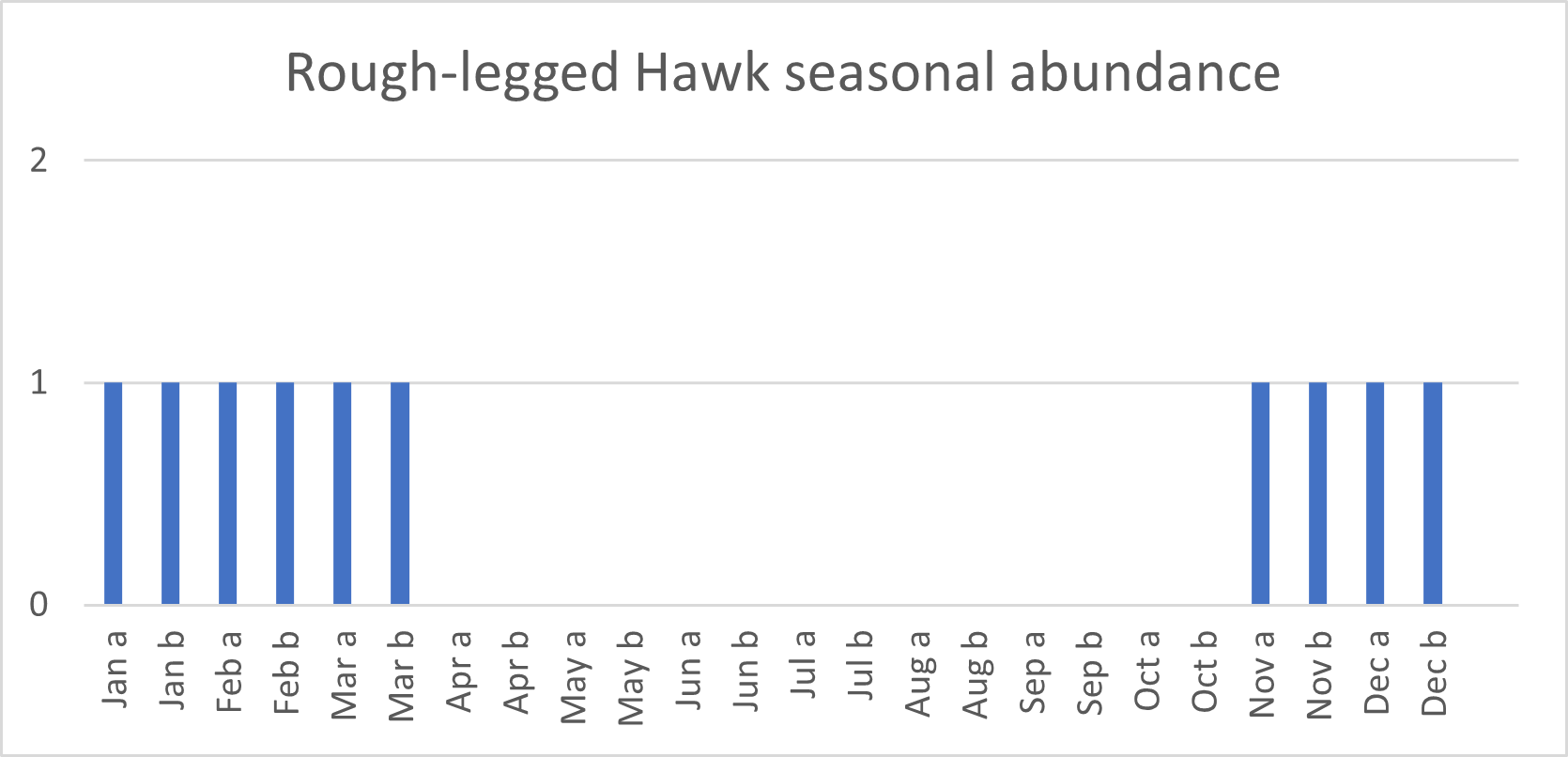
Like several related hawks, Rough-legged Hawks come in two color morphs: light and dark. The former is more common in New Hampshire and is marked by a streaked buffy head and breast that contrast with a dark brown belly. The dark morph is completely dark brown. Both variants have a distinctly bicolored tail that is white at the base and dark at the tip. Females tend to be larger and paler than males. Rough-legged Hawks are only found in New Hampshire from November to March and can’t be reliably found every winter. They are most likely as migrants along the Connecticut Valley and Seacoast.
Relative abundance based on eBird data. Numbers indicate likelihood of finding this species in suitable habitat at a given time of year, not actual numbers encountered.
Rouogh-legged Hawk Range Map
= Breeding
= Winter
= Migration
= Year Round
Information for the species profiles on this website was compiled from a combination of the sources listed below.
The Birds of New Hampshire. By Allan R. Keith and Robert B. Fox. 2013. Memoirs of the Nuttall Ornithological club No. 19.
Atlas of the Breeding Birds of New Hampshire. Carol R. Foss, ed. 1994. Arcadia Publishing Company and Audubon Society of New Hampshire
Birds of the World. Various authors and dates. Cornell Laboratory of Ornithology.